
上海市社科联 2026 学术合作项目
科学食膳 赋能健康
第三届“饮食营养与健康专家论坛暨营养与疾病防治”学术会议
复旦大学公共卫生中心 张玮主任 远程连线论述研讨
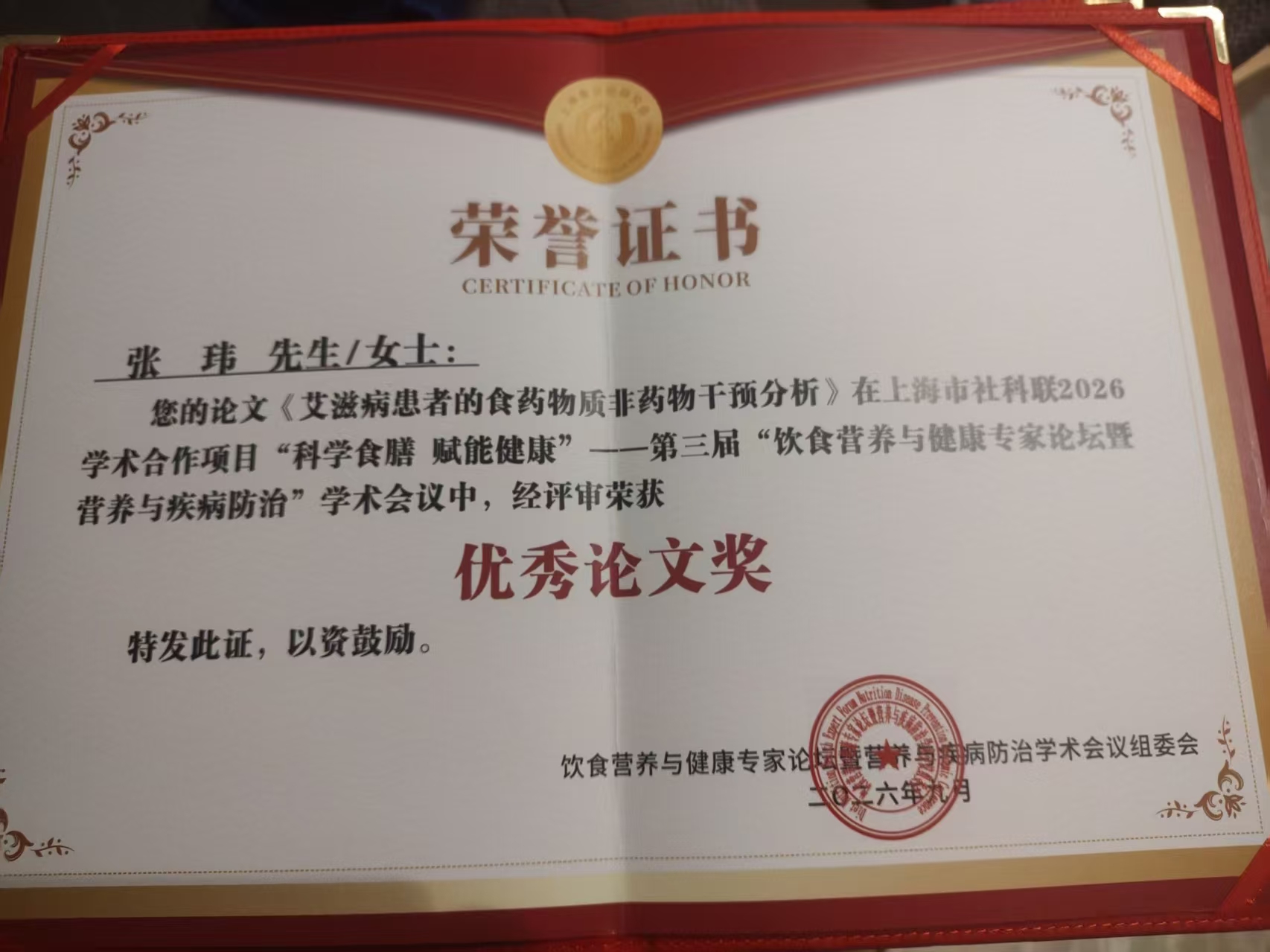
艾滋病患者的食药物质非药物干预分析 获得优秀论文证书
艾滋病患者的食药物质非药物干预分析
复旦大学公共卫生中心 张玮主任
【摘要】艾滋病(HIV 感染)是严重的免疫缺陷性疾病,抗逆转录病毒治疗(ART)是核心治疗手段。在规范抗病毒治疗基础上,食药物质作为膳食非药物干预手段,可通过调节肠道微生态、减轻慢性炎症、补充微量营养素、改善机体营养状态,辅助维护免疫功能、缓解药物不良反应、提升患者生存质量。本报告结合公共卫生视角,梳理 HIV 感染者/艾滋病患者的营养病理特征,分析药食同源食药物质的作用机制、适宜应用场景,探讨现有研究证据、现实局限、应用风险,提出食药物质非药物干预的实施原则与公共卫生管理建议,明确食药物质不能替代抗病毒药物,为艾滋病患者膳食健康管理提供循证参考。
【关键词】艾滋病 HIV 感染者 食药物质 非药物干预 肠道免疫 公共卫生营养
【论述研讨】HIV 病毒持续破坏 CD4⁺ T 淋巴细胞,造成机体免疫损伤,同时引发肠道屏障破损、肠道菌
群紊乱、持续性低度慢性炎症,伴随能量代谢亢进、蛋白质大量消耗,极易发生蛋白质‑ 能量营养不良。即便接受规范 ART 抗病毒治疗,部分患者仍存在肠道功能异常、代谢紊乱、免疫重建不全、体重下降、机会性感染风险高等问题。当前艾滋病防控已经从单纯抗病毒治疗转向“抗病毒治疗+营养支持+心理社会干预”的综合管理模式。食药物质是我国传统膳食资源,以药食同源植物、食材提取物为主体,属于膳
食层面的非药物干预手段。在公共卫生层面,合理应用食药物质,能够作为临床治疗的辅助补充,改善患者营养状况、降低并发症风险,提升患者生活质量,对艾滋病的全周期健康管理具有现实意义。所有食药物质干预均建立在规范坚持 ART 治疗基础之上。严禁宣传食药物质可以“治疗艾滋病、清除病毒、替代抗病毒药”,这是临床与公共卫生层面的红线。
【总结】在艾滋病综合防治体系中,规范抗逆转录病毒治疗是根本,食药物质作为膳食非药物干预手段,能够在肠道保护、抗炎抗氧化、改善营养状态方面发挥积极作用。但现阶段证据仍有限,必须严守科学边界,杜绝夸大功效,防范药物相互作用风险。从公共卫生角度,应当把食药物质膳食干预作为艾滋病全周期健康管理的补充环节,依托“科学膳食、赋能健康”理念,推动循证、安全、个体化的膳食营养干预措施,更好服务 HIV 感染者与艾滋病患者,助力艾滋病的综合防治事业发展。
地址:上海食文化研究会会议室 会议时间:2026 年 9 月 17 日
Shanghai Social Science Federation 2026 Academic Cooperation Project
Scientific diet empowers health
The 3rd "Diet, Nutrition and Health Expert Forum and Nutrition and Disease Prevention and
Control" Academic Conference
Non-drug intervention analysis of the food quality of AIDS patients
Public Health Centre of Fudan University Zhang Wei
【Abstract】AIDS (HIV infection) is a serious immunodeficiency disease, and antiretroviral therapy(ART) is the core treatment. On the basis of standardising antiviral treatment, food and drug substances, as a means of dietary non-drug intervention, can regulate intestinal microecology, reduce chronic inflammation, supplement micronutrients, improve the body's nutritional status, assist in maintaining immune function, alleviate adverse drug reactions, and improve the quality of patient life. Based on the perspective of public health, this report sorts out the nutritional and pathological
characteristics of HIV-infected/AIDS patients, analyses the mechanism of action and suitable application scenarios of medicinal food homologous food quality, explores the existing research evidence, practical limitations and application risks, and puts forward the implementation principles of non-drug intervention of food and drug quality and public health management. It is clear that dietary substances cannot replace antiviral drugs, so as to provide evidence-based reference for the dietary health management of AIDS patients.
【Keyword】AIDS, HIV infected, food and drug quality, non-drug intervention, intestinal immunity, public health nutrition
【Discussion】HIV virus continues to destroy CD4+T lymphocytes, causing immune damage to the body. At the
same time, it causes intestinal barrier damage, intestinal flora disorder, persistent low-grade chronic inflammation, accompanied by hypermetabolism of energy and large amounts of protein consumption, which is very prone to protein-energy malnutrition. Even after receiving standardised ART antiviral treatment, some patients still have problems such as intestinal disfunction, metabolic disorders, incomplete immune reconstruction, weight loss, and high risk of opportunistic infection. At present, AIDS prevention and control has changed from simple antiviral treatment to a comprehensive management mode of "antiviral treatment + nutritional support + psychosocial intervention". Food and medicine substance is a traditional dietary resource in China. It is a non-drug intervention method at the dietary level, with medicinal and food-food homogenous plants and food extracts as the main body. In terms of public health, the rational application of food and drug substances can be used as an auxiliary supplement to clinical treatment, improve the nutritional status of patients, reduce the risk of complications, and improve the quality of life of patients, which is of practical significance to the full-cycle health management of AIDS. All food and drug quality interventions are based on the standardised adherence to ART treatment. It is strictly forbidden to publicise that food substances can "treat AIDS, remove viruses, and replace antiviral drugs", which is a red line at the clinical and public health levels.
【Summary】In the comprehensive AIDS prevention and control system, it is fundamental to standardise antiretroviral treatment. As a dietary non-drug intervention means, dietary substances can play a positive role in intestinal protection, anti-inflammatory and anti-oxidation, and improve nutritional status. However, at this stage, the evidence is still limited. We must strictly abide by the boundaries of science, stop exaggeration of efficacy, and prevent the risk of drug interaction. From the perspective of public health, dietary intervention should be taken as a supplementary link to the whole cycle of health management of AIDS. Relying on the concept of "scientific diet, empowering health", we should promote evidence-based, safe and individualised dietary nutrition intervention measures to better serve HIV-infected people and AIDS patients, and help the comprehensive prevention of AIDS. Govern the career development.
Address: Conference Room of Shanghai Food Culture Research Association Meeting
Time: September 17, 2026
审撰 :食药物质 健康中国栏目组 愚晏
摄影 :冯赟超 陈金宝
翻译 :国际食药物质与健康产业联盟 执行秘书长 孙丽
校对:国际疾病非药物干预科学应用联盟(中国代表处)执行秘书长 吴玲

 沪公网安备31011502404498号